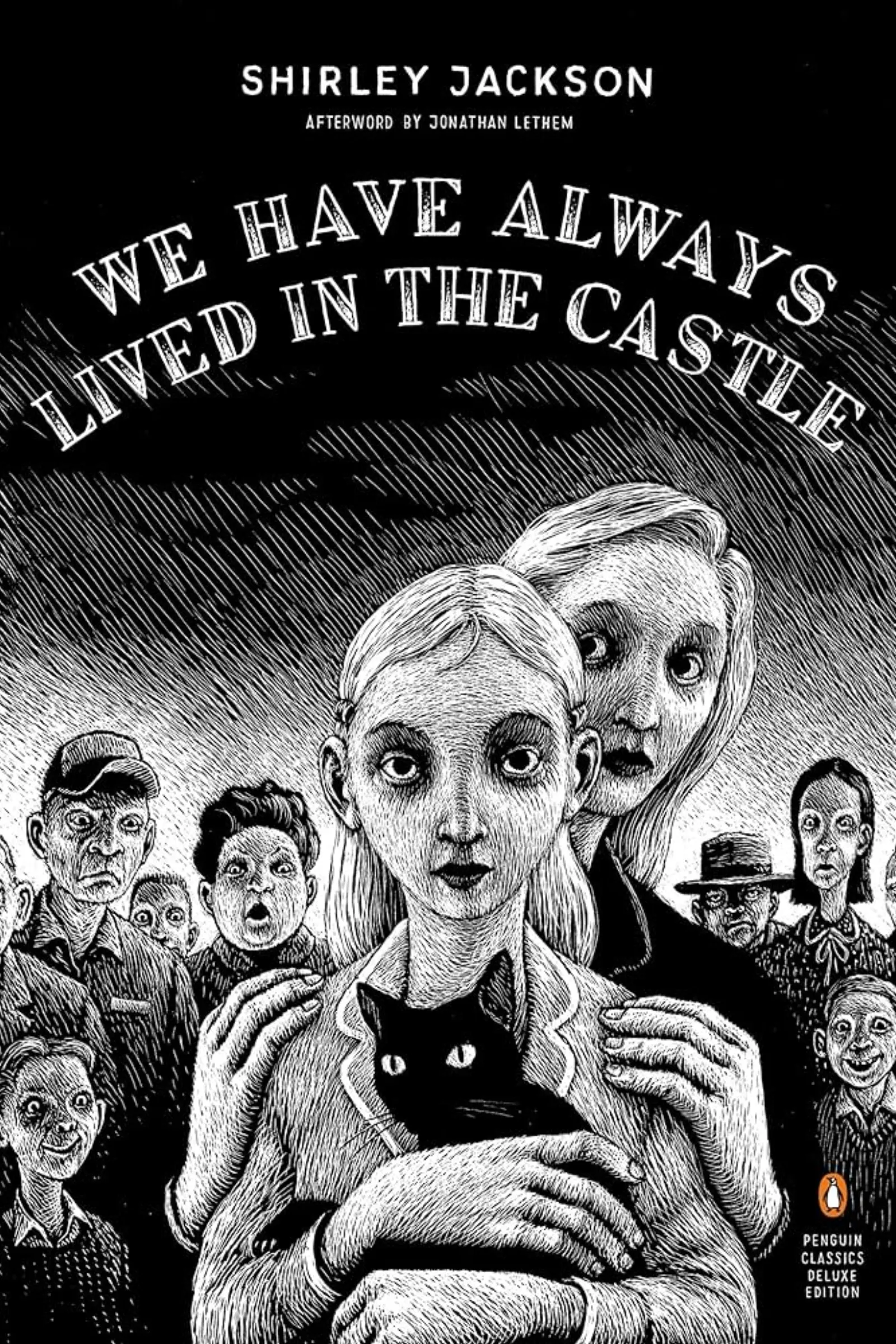
In the ambiguously crafted world of We Have Always Lived in the Castle, Shirley Jackson presents truth as a malleable construct, revealing how characters shape and manipulate reality to suit their own individual motives. Pursuing an elusive notion of the truth, Jackson explores how characters respond to its mutable nature, often creating new realities and constructs as a result.
In establishing the elusive nature of truth, Jackson constructs a world in which characters are in constant pursuit of their own notion of reality. As a consequence of Constance's exoneration of the Blackwood poisoning six years prior, the people of the village never truly found out who was responsible, leading them to pursue their own narrative and idea of the truth. Their "jeering and mocking" of the sisters can therefore be inferred as a pursuit of their own interpretation of reality, as their nursery rhyme still attributes the murders to Constance. Ironically, although Merricat reveals herself to be the family's murderer, the villagers' rhymes still have her rejecting Constance's care on the basis that "[she] will poison [her]". Within such a blatant dismissal of Constance's innocence, Jackson consequently suggests that characters will pursue their own notion of reality, as the truth is shown to be elusive and unable to be truly reached. Jackson further uses Mrs Wright as a vehicle for exploring the elusive nature of truth and the characters' determined pursuit of it. "[overstaying] all limits of decency", she is depicted to be deeply curious of the truth and intent on "really find[ing] out what happened". Such a pursuit of the truth is still shown to be tainted by preconceived ideas, as she continuously explores the hypothetical scenario of "if [Constance] is a homicidal maniac", despite having "met her" a few moments prior. Conceding that even she had "forgot[ten]... that the pretty young [Constance]" was the subject of the story, Mrs Wright acknowledges that her seemingly innocent pursuit of the truth is tainted by conjecture, as Jackson establishes the evasive nature of the truth.
Jackson further suggests truth to be a malleable construct, exploring how its presentation can be easily manipulated. Through her use of Merricat's unreliable narration, she leaves readers to decipher the truth, using a first person perspective to examine her characters' reality. Jackson's construction of "Charles' fire" explores how Merricat diminishes her culpability in the subsequent destruction of the Blackwood family home, seeing the blaze as mere shades of "gold and yellow", offering a naive understanding of consequence to navigate accepting the responsibility of starting the "flame" that "consumed" their home. Such a disconnect from her actions, therefore, displays how Jackson uses the novel's unreliable narration to establish how the truth can be manipulated, suggesting it to be fluid and changeable in nature. This notion is further explored through Uncle Julian's interaction with reality, especially through his writing of the book on the Blackwood murders. Conceding that he too is responsible for bending the truth, Uncle Julian boldly claims that he would like to "commence with a slight exaggeration… then go into an outright lie", suggesting he sees little issue with moulding the truth to achieve a more interesting novel. Beyond Julian's conscious manipulation of the truth, however, Jackson uses the character's failing memory to further challenge readers' understanding of the nature of truth and its objectivity. In a bold assertion the sisters' uncle claims "Merricat died in an orphanage of neglect", despite being depicted by Jackson to have shared tea with her just moments before. Not only is Julian's novel questionable, therefore, but his perception of the world of the text, and Jackson's construction of the relationship between characters. As a consequence, readers are left with an understanding of the ambiguity of the nature of truth in the novel, as its presentation is altered and manipulated by its characters.
Within the sisters' isolation at the end of the text, Jackson consequently demonstrates how easily myths and legends are formed as she explores the innate instability of truth and its susceptibility to change. As the people of the village "move like a wave" against the Blackwood house, many are chanting the verses of the nursery rhyme that Merricat has grown to despise. "Rhythmic and insistent", the chant is shown to have found its way into the village psyche, a truth by which the hysterical mob feel justified to sack the Blackwood house. The fear of the villagers at the end of the text further reflects the ease with which new truths can be established, as the perception of the Blackwood sisters as 'witches' is developed. "If you [go on the steps of the house], the ladies will get you" warns a child to his friend, as the seclusion of the women within their titular "castle" has sparked a new round of speculation and conjecture about the Blackwoods. The "tall tales" told by "the local people" have integrated into the village gossip, becoming a new reality as they warn their children to not stray too far, else risk being "eat[en]... by the ladies". The construction of the Blackwood sisters as witch-like recluses, therefore, reflects the ease with which local legends and new truths are often, by nature, established out of "gossip" and conjecture.
Diminishing any chance for objective truth in her novel, therefore, Jackson offers varying realities from the viewpoints of her characters as she establishes its malleability. Using the pursuit of truth and creation of town legends, she challenges readers to look beyond the narrow scope of the novel's unreliable narration, and see how truth is constructed from varied perspectives.