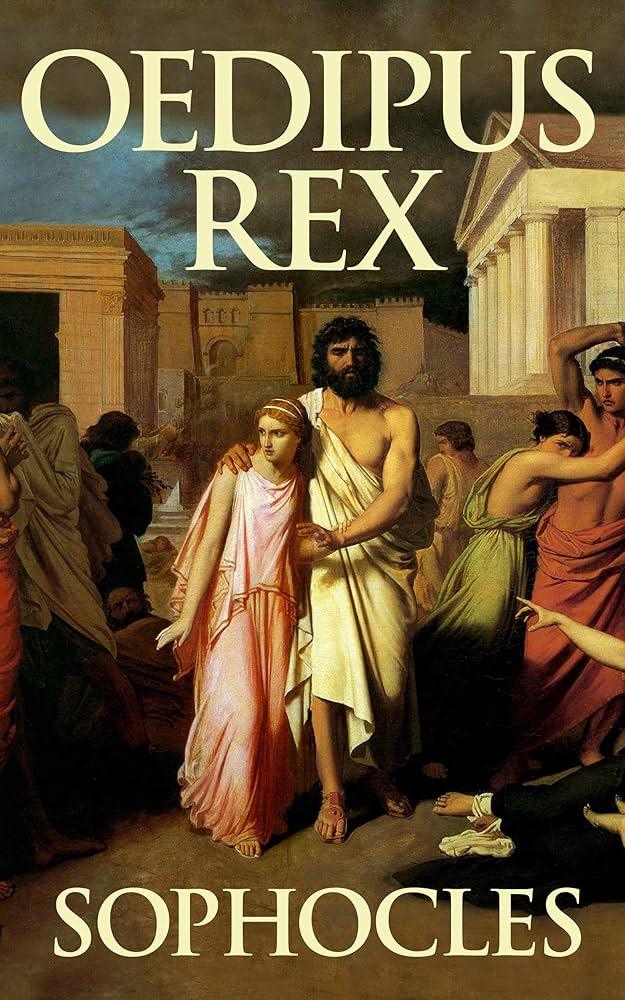
In Oedipus the King, Sophocles constructs a world where human suffering is ubiquitous. Despite its writing in 429 BCE, a bygone era unknown and unrelatable to the majority of the contemporary 21st century audience, Sophocles' chilling presentation of tragedy as an inexorable fact of human life remains unnerving. Particularly, it is through the downfall of the eponymous Oedipus, the venerated king of Thebes, as he becomes a blinded, grief ridden man that is now an outcast from the city that this notion is underscored. Sophocles' adherence to Aristotelian conventions of tragedy further engineer a world where suffering is the uneasy plight of humanity.
In Oedipus the King, Sophocles presents fate as a rigid framework dictating the boundaries of human possibilities, in turn causing suffering. This notion is made relevant foremost in the role of prophecy within the play, Oedipus who is "born for pain" is destined to "kill [his] father" and "couple with [his] mother" even prior to achieving individualistic consciousness. By presenting Oedipus as doomed from the onset, Sophocles invokes dramatic irony, wherein audiences are unnervingly aware of the fate that is to befall the blissfully ignorant Oedipus. His agony, then, is fated. Similarly, Sophocles dismisses all attempts to outrun the "dread voices of Delphi" as ultimately futile. Jocasta, who dares to suggest that the god of prophecy, Apollo, declined from bringing her husband's "fate to pass", is later unable to confront the grave error of her erroneous decision making, opting instead to hang herself. Similarly, Oedipus's decision to flee to Corinth upon hearing the Delphic prophecy only sets him upon the crossroads where he kills Laius, in cold blood, and to Thebes, where he marries Jocasta, ironically achieving exactly what he was "taking pains" to avoid. Sophocles vehemently rejects the notion of man outrunning fate, which is reminiscent of his disapproval of the burgeoning humanist sentiments that were emerging within his socio-historical milieu. In Oedipus the King, all attempts made by characters to construct their own fate are ultimately meaningless. In direct concordance, Sophocles also suggests that the man who lives moderately and does not venture beyond the boundaries of divine decree is solely capable of escaping insurmountable agony. The "calm" and "rational" Creon who is wholly devoid of a "thirst for power" avoids individual tragedy, yet even he is subject to the grief of violently losing his sister to death and his brother-in-law to exile and misery. Therefore, Sophocles extols moderation as a virtue that allows man to lead an honourable existence whilst simultaneously affirming the ubiquity of suffering as foundational to the human experience. Through the tumultuous push and pull of characters against the nexus of fate and free will, Sophocles presents human nature as inherently fallible and in its flaws, presenting the overwhelming potential to be constructs of their own devastating ruin.
Sophocles staunchly furthers the notion that individual hamartia only accelerates the pace of ruthless divine ordinance, in turn magnifying their own agony. In his address to the Theban denizens, Oedipus brazenly proclaims, "You pray to the gods? Let me grant your prayers." By likening his power to that of a god, Oedipus places himself upon the pedestal of divinity when, in reality, even "his children" are well aware that "[he] cannot equal the gods." Due to its placement in the prologos component of the play, a sense of Oedipus' fatal hubris unnervingly crystallises before the audience. Later, when the titular character exclaims, "I must know it all, must see the truth at last," the depth of Oedipus's hubris is revealed, he seeks to encroach upon the areas that the god's jurisdiction whilst the repetition of "must" paints this notion as visceral, a sort of all encompassing need. Through this, the audience is made to recognise Oedipus's hubris as his hamartia, the flaw that will ultimately catalyse his doom. Indeed, this sentiment is later echoed in Oedipus's moment of catastrophe, the Ancient Greek component of tragedy wherein the previously mighty hero, having recognised the error of his or her judgement, undergoes enormous suffering and humiliation. Upon blinding himself, he proclaims, "[of his eyes] too long have [they] looked upon the ones [they] should have never seen, longed to know the ones [they] never should have known." As a consequence of his prior hubris, Oedipus is catastrophically blindsided by the revelation of his true actions, opting to blind himself. As the grief stricken Oedipus gouges out his eyes, Sophocles engineers a paradox: the sighted Oedipus, who was blind to the sin of his life, becomes the blinded Oedipus, feeling his way away from the city, yet in the darkness seeing the light of understanding. The power of individual flaw in birthing relentless agony is also made clear through Jocasta's cynical dismissal of the gods' laws as "neither here nor there". As Jocasta exhibits a blasphemous refusal to submit to the often esoteric and cruel gods' laws, the inexorable progress of the play imposes upon her inconceivable suffering. Jocasta's decision to commit suicide is a direct byproduct of her inability to grasp the enormity of the realisation that her beliefs were completely and utterly wrong, consequentially destroying her sense of self. By condemning characters' flaws, Oedipus the King suggests human nature is predisposed towards creating our own suffering.
Sophocles' masterwork adheres to the conventions of Greek theatre, instilling catharsis in its audience through its structural characteristics that create the relentless agony of its characters. Particularly, the use of a single setting and an extremely limited timespan engineer the progress of play, reflective of Aristotle's unities of drama. Tireseas also proclaims, "This day will bring the truth of [Oedipus's] birth and ruin", underscoring how the limited chronology intensifies Oedipus's suffering so much so that he learns the truth of his birth, knowledge that he had been yearning to grasp for his entire life, to his catastrophic downfall. In a similar vein, Sophocles utilises the underlying conservatism of his chorus to question the ideological nuances that underpin ideas raised in the play. In its exodus, the Chorus remarks, "Count no man happy until he dies, free of pain at last." The Chorus's bleak moralising does not attempt to dampen or alleviate the extent of the horrors witnessed by the audience, but rather frames the events of Oedipus the King as a powerful microcosm of humanity. Just as suffering is relentless in the world of the play, Sophocles contends that suffering is just as pervasive in the world as a whole. This is markedly in accordance with the ultimate goal of the tragic drama to elicit terror and pity in the audience. By forcing them to confront their own place under the divine hierarchy of the universe, Sophocles uses this to make the audience feel the twin emotions for themselves, as humans subject to divine decree, just as much as for the fallen tragic hero Oedipus. This notion ultimately recalls Sophocles' own conservatism and the Athenian values of piety and subservience in the face of the gods.
Sophocles' Oedipus the King is an examination of what it means to be human, ultimately suggesting that agony is as relentless in the real world as it is in the play. The culmination of human dismissal of fate, our flaws and idiosyncrasies, and the progress of time bring about relentless agony, both in the play and in our world.