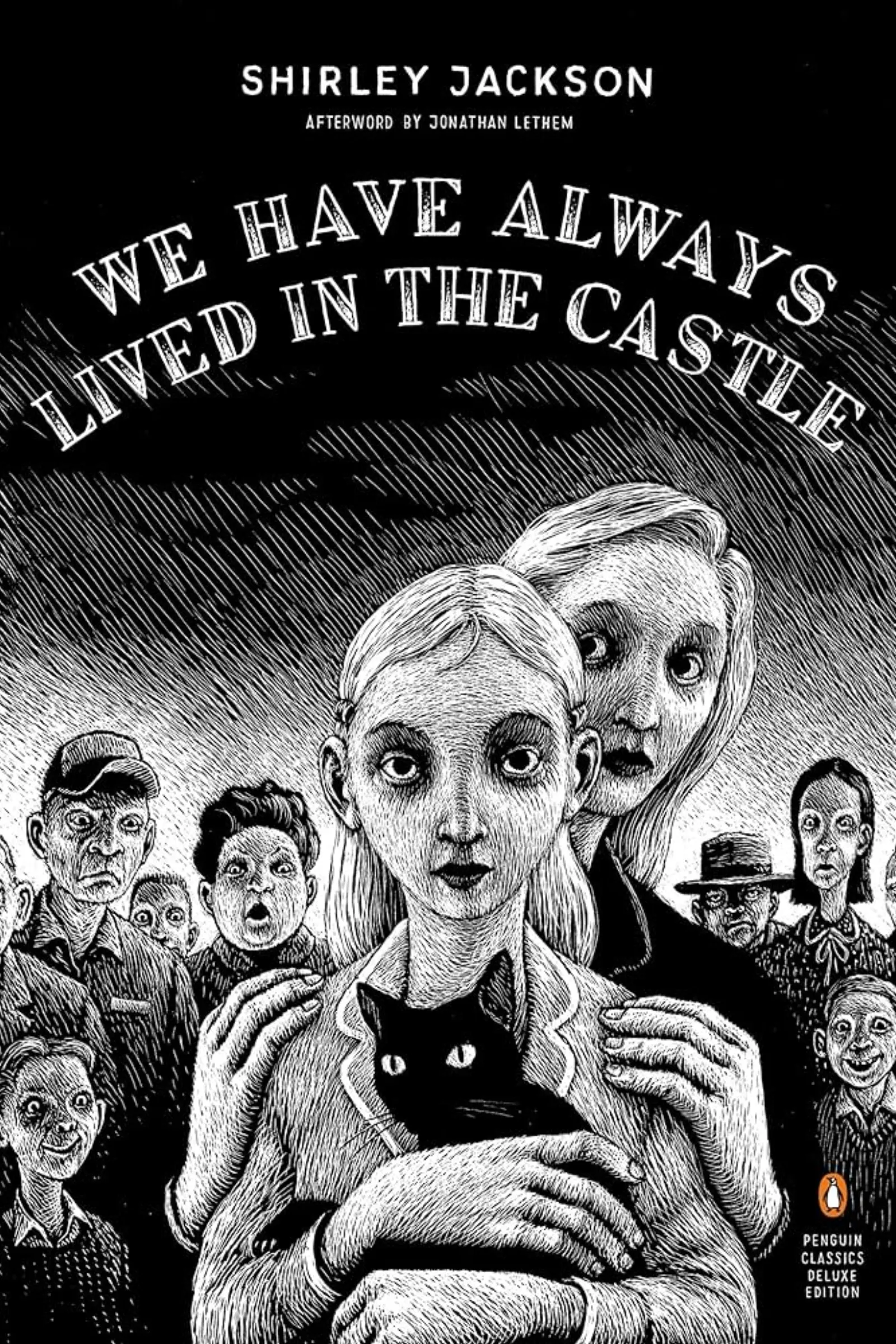
Shirley Jackson's American-Gothic novel, We Have Always Lived in the Castle, serves as a nuanced dissection of the sundry social issues plaguing American society at its time of genesis in the 1950s and 1960s. In her novel, Jackson propounds the notion that the unfortunate stratification of society ultimately stems from a lack of interpersonal empathy, operating on various levels of social discourse. It is through the ambivalent interactions of individuals and communities in the novel that Shirley Jackson's critique of the moral wasteland underpinning pervasive lack of empathy is revealed.
Shirley Jackson laments the role of social and economic disparity in fuelling resentment within the two major community groups, the Blackwood family and the village, divulging the such as debilitating to both parties. This notion is foremost foregrounded in Merricat's visitation to the village in Chapter 1, where she displays an unnerving lack of empathy for the villagers' lives and livelihoods, depicted wishing that she could "come into the grocery one morning and see them all dead" so that she "[c]ould step over their bodies and help herself." Whilst, ostensibly, this first encounter with Merricat's obsessive and patently violent ideation is jarring to the reader, it also seeks to establish the disturbing lack of positive relations between the Blackwood family and the villagers, despite the former's unvarnished dependence on the latter for "food and library books". As such, Jackson forewarns against the role of lack of empathy in blindsiding communities against recognition of their interdependence upon each other, leading to insidiously violent outcomes. In the same vein, Merricat's assertion, "the people of the village have always hated us [the Blackwoods]", crystallises the notion of tense community relationships as not only emerging from the incident of the poisoning six years prior to the start of the novel's events, but rather a legacy that outlasts even Merricat's own birth. In the villager's ironically scathing assertion that "the Blackwoods always did set a fine table," the socio-economic underpinning of this discord between the two monolithic communities is divulged, the villagers' abuse is, consequently, a manifestation of their resentment at the Blackwood family's elevated social status and patent sense of superiority over the villagers that fuels their highbrow distaste. This even crystallises in the form of John Blackwood fencing his "Blackwood property, from the highway to the creek" against the uncivilised assault of the "grimy" villagers. It is through this lens that Jackson presents a cautionary tale warding against the growing socio-economic disparity of the 1950s, whilst the post-war economic boom ensured lucrative financial uprise for some, individuals belonging to marginalised communities remained enshrined within the quagmire of their limited economic prospects. Therefore, Jackson tolerates a reformation of social perspectives in reducing this problematic disparity, particularly in the form of Constance's almost parental chide at Merricat that "it was wrong to hate them," and her subsequent immediate and inflammatory dissent that, "but [she, Merricat] hated them anyway." As such, Jackson presents the uncomfortable contribution of rigid social biases in perpetuating dissent between communities.
In We Have Always Lived in the Castle, lack of empathy serves as a significant barrier between interpersonal connection, preventing characters from actualising their unvarnished yearns to form and maintain positive social relationships. Most notably, this notion can be seen in Charles Blackwood's uninvited arrival at the Blackwood manor. Despite being a cousin who has not maintained contact with the Blackwood sisters for a number of years, Charles is quick to subjugate the Blackwood household to his domineering, patently patriarchal will, such as when he unearths Merricat's box of silver dollars and forcefully asserts that it is "not her money" and that "she has no right". This sparks overt resentment in Merricat, who sadistically envisions "turn[ing] him into a fly and watching him, helpless and struggling and dying," wherein the polysyndeton only amplifies her emotional tumult at the curtailing of her individual autonomy. Therefore, Jackson bemoans the restrictive patriarchal tenets as engendering fragmentation and antagonism in female figures, perhaps microcosmic of the unyielding gender roles of the 1950s and 1960s, which extolled the position of homemaker and mother as the only acceptable positions for women, affording them little to no capacity for self determination beyond the ubiquitous fetters of the control of their fathers and husbands. This psychological deterioration, stemming from a male denouncement of feminine capabilities, can also be seen succeeding Merricat's interaction with Jim Donell at Stella's cafe at the start of the novel, where Jim Donell, a domineering, physiologically powerful male figure, first physically restricts Merricat's ability to leave the situation by "swinging his legs sideways on the stool." Furthermore, he continues to repetitively taunt her with the satirically virulent jeers, "Somebody told me you'd [the Blackwood sisters] would be leaving soon." Most notably, however, is that his behaviour causes Merricat to anticipate further and more gratuitous violence, made salient in her thinking that, "very likely he would throw his coffee in [her] face." As such, Jackson denounces the reductionistic and patently patriarchal view of women held by men, which, in turn, manifests in further resentment and fragmentation in the psyches of female figures in We Have Always Lived in the Castle.
In the novel, the othering of individuals and communities into polarising factions is not only shown to be deeply problematic, but also divulged to stem from insidious hatred and a marked lack of empathy. In the scene of the decimation of the Blackwood manor that also serves as the climax of the novel, the villagers repetitively, resoundingly and terrifyingly state, "Why not let it burn, Jim?" Herein, the extent of their conditioned nonchalance for the Blackwood family metamorphoses into a plain hatred, which causes them to demolish the Manor in a deliberate and terrifying act of destruction. Through this, Jackson presents a scathing critique of the mob mentality prominent in America in the 1950s and 1960s, where the Red Scare, or the pervasive fear of Communist infiltration into quotidian American life, caused both individuals and governments to collectively perform horrific acts of social ostracisation. Conversely, through the villagers' limited repentance at the conclusion of the novel, namely, in the form of gifts of food with performative notes of apology such as, "Sorry about your harp," a limited capacity for empathy is revealed. However, given the insurmountable destruction of the Blackwood manor, these messages of sympathy are ultimately rendered paltry, only meagrely restorative towards the sisters' isolated situation through the presentation of sustenance. As such, Jackson unnervingly displays the human propensity for horrific violence under the indoctrination of a mob, ultimately and resoundingly denouncing the initial lack of empathy as generating disastrous social consequences.
In We Have Always Lived in the Castle, Jackson cements the notion that a lack of empathy is a potent progenitor of pervasively negative repercussions. Furthermore, in her novel, these repercussions are shown to be comprehensive, deteriorating lives, livelihoods, and legacies.