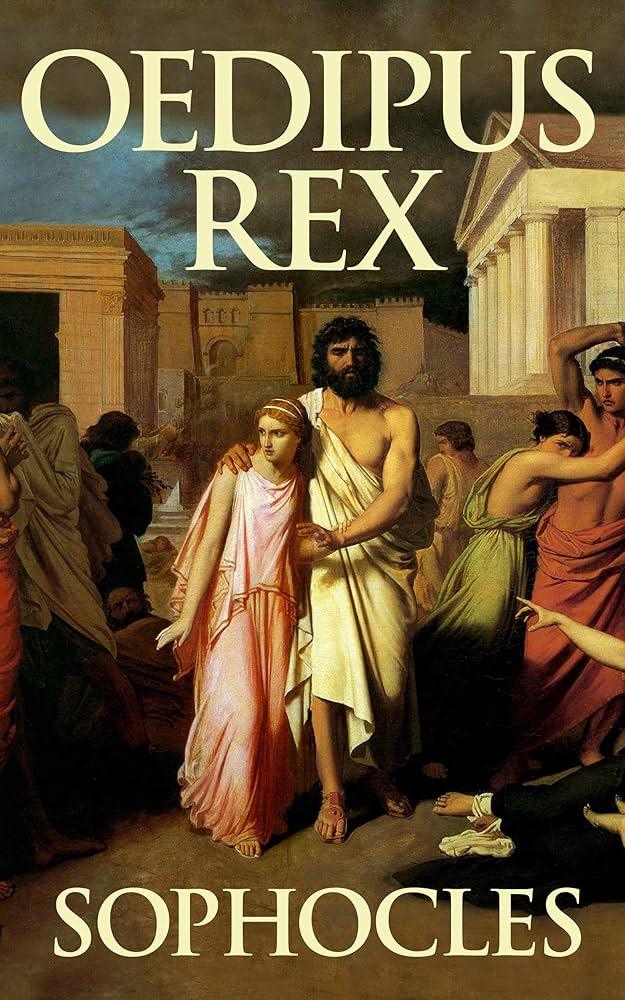
In Sophocles' Oedipus the King, there is a pervasive examination of the repercussions of man's fatal flaws in causing their own suffering. Sophocles posits hubris as only one of the factors that herald the metamorphosis of Oedipus, the venerated king of Thebes, from his characteristic gaiety and pride to his later downfall, where he becomes Oedipus solely concerning sin. As Sophocles' narrative imposes greater and greater suffering upon Oedipus, his hubris, which is ultimately his fatal flaw, only accelerates its dreadful pace. Due to its adherence to the structure of classical Greek tragedy, Sophocles' drama remains a harrowing beacon, warning against pride in the face of the gods, cementing the Ancient Greek belief that no mortal, despite one's grandeur, is ever exempt from divine retribution.
Sophocles reasserts the notion of destiny as a framework, suggesting that an overarching universal law exists that dictates the boundaries of human possibilities. In Oedipus the King, pride is portrayed merely as the resultant of the remnants of the limited agency man possesses within that sphere. Regardless of his individualistic flaws, no man is exempt from divine decree. This notion is elucidated through Oedipus's downfall. In the prologos, Oedipus exhibits heinous hubris in the face of the gods, even brazenly proclaiming to the Theban citizens, "You pray to the gods? Let me grant your prayers." In contrast, Oedipus's fate to "couple with [his] mother" and "kill [his] father" was destined even prior to his birth. Oedipus's tragedy can be ostensibly perceived as a product of his hamartia, but contextual placement suggests that he was doomed from the onset as directly reflected in the drama, the Shepherd announces that Oedipus was "born for pain". Perhaps then, the unquestionably rigid nature of Oedipus's fate is a reflection of the Athenian values, which regaled piety and subservience in the face of the gods. Particularly, the conservative Chorus's patent "dread" worship of the pantheon in their foremost address cements this sentiment, which characterises their broader structural contribution to Oedipus the King as a whole. In the same vein, Jocasta, who dares to muse that "chance may rule [our] lives", seeking to expose divination as mere charlatanism, meets an unfortunate and chilling end that ultimately echoes the prophecy given to her and Laius. As such, the playwright's view of deviation from divine decree as inherently blasphemous is further concurred. Through the representation of Oedipus's tragedy as fated irrespective of his individual flaws, Sophocles underscores the ubiquity and absolute power of the gods' laws.
In Oedipus the King, Sophocles presents the inextricably grave relationship between human flaw and tragedy, the former only seeks to accelerate the latter, only making divine retribution all the more devastating. Oedipus's hubris, where he seeks to act almost akin to a "god" to the Theban people is originally what sets him upon the warpath that brings his own suffering. This sentiment is most markedly depicted in his proclamation that he will "bring it all to light [him]self", suggestive of his unflinching belief in his ability to resolve all. Oedipus's pride only amplifies his suffering throughout the play's inescapable progress. For example, when Oedipus rages, "You [Tireseas] can't hurt me or anyone else who sees the light, you can never touch me," a sense of dramatic irony is impressed upon the audience as blindness potently foreshadows Oedipus's end. Oedipus's unwavering conviction that he knows the truth leads him to be catastrophically blindsided by "the corruption of [his] life". The impact of the devastating dissolution of his pride, the peripeteia, the reversal of fortune, causes him to commit the ritualistic act of self blinding, stating his eyes were "too long blind in the darkness, blind!" The rhythmic repetition of "blind" aggrandizes the contribution of his pride in hindering his perception, creating a paradox where Oedipus, the previously sighted man who was blind to his identity, becomes the blinded man feeling away from the city he was considered "native" to, yet, in the darkness, seeing the light of the understanding that eluded him prior. Through the twin motifs of light and dark and sight and blindness, Sophocles suggests that the devastating totality of Oedipus's suffering was compounded as a result of his individual pride.
Oedipus the King acts as a cautionary tale, warning audiences against the mortal sins of pride and cruelty. In Ancient Greece, the tradition of play was seen as a significant form of moral and religious observance, ultimately seeking to impress upon the audience a virtuous code of conduct. This is echoed in Sophocles's choral odes, which reflect the underlying conservatism of his socio-historical milieu. As the Chorus proclaims, "Destiny find me filled with reverence," there is a marked reassertion of the absolute power of the gods. Due to its structural placement, flanking Jocasta's crass dismissal of prophecy being "neither here nor there", Sophocles directly condemns those that undermine the authority of the gods. Furthermore, Sophocles highlights moderation, a prized Athenian virtue, as fundamental to an honourable existence. Creon's words, for example, are laden within his "self control" and "calm and rational" nature, wholly absent of a thirst for power. Although he loses his sister, Creon is the only character absent from suffering at the conclusion of the play, and therefore, is the vehicle through which Sophocles suggests that a man who obeys the imposed boundaries of divine decree is of paramount virtue. In contrast, Oedipus, who does not prescribe to these characteristics, meets a brutal end. Following his cruel profanities to Tireseas, the chorus remarks, "Pride breeds the tyrant," suggesting an individual with hubris will be the architect of not only his own suffering, but of those around him as well, as chillingly seen in Oedipus's case, whose sin brings a miasma of corruption upon the city of Thebes. As such, Sophocles' homogeneous characterisation of the Chorus, despite not existing as a concrete character, as conservative, morally rigid and religious extols their views as the standard in Athenian society. In adherence to the conventions of Greek theatre, Sophocles purports that individual pride catalyses the breakdown of virtue in society as a whole.
Sophocles' Oedipus the King is an exploration of what makes us human, from our hamartia to our fundamentally mortal inability to govern our own destiny. In his great tragedy, Sophocles paints pride as a harbinger of ruin of both ourselves and those around us, whilst tempering this with an affirmation of the limits of human agency in a world that is governed by the gods.